|
Culturally, Chamatkar belongs to a lineage of Indian films that use fantasy elements to stage social critique while remaining broadly family-oriented. Its ghost is not an object of horror but a moral catalyst—an emissary that compels living characters to confront their compromises. This positions the film as both entertainment and ethical fable: it asks audiences to consider what debts—moral, social, interpersonal—remain unpaid in their own lives.
Chamatkar is a 1992 Hindi-language fantasy comedy-drama directed by Rajiv Mehra, starring lateef Amitabh Bachchan, Naseeruddin Shah, and Shah Rukh Khan in an early-career supporting role. The film blends sentimental family melodrama with light supernatural whimsy, built around an improbable central conceit: a wronged, recently deceased man returns as a ghost determined to secure justice for his living friend and to set right the small, human debts left unpaid.
In sum, Chamatkar’s indexable significance lies less in technical innovation than in its tonal blend of warmth, humor, and moral insistence. It is a film that trades on star power and familiar genre beats to deliver a simple, affecting argument: small people, allied by courage and conscience—and occasionally, by a little supernatural help—can demand accountability from the powerful. As a cinematic object, it remains a gentle, nostalgic example of early-1990s mainstream Hindi cinema, notable for performances and a premise that turns grief into a purposeful, redemptive mission. Index Of Chamatkar Movie
Performances are central to Chamatkar’s lasting appeal. Amitabh Bachchan, even in limited screen time, imbues the ghostly teacher with warmth and principle; his presence lends the film emotional weight. Naseeruddin Shah, as the protagonist, grounds the film with naturalism—his comic timing and capacity for quiet sincerity create a character one can root for. Shah Rukh Khan, in a supporting role, offers early hints of the charisma that would soon make him a superstar; his cameo-like energy adds youthful verve without distracting from the core relationship.
One notable dimension of Chamatkar is its treatment of power and smallness. The antagonists—corrupt landlords, unscrupulous businessmen, or complicit officials—are not mythic monsters but plausible social predators who exploit legal and economic asymmetries. The hero’s victory, aided by a supernatural ally, is therefore not merely plot mechanics but a symbolic restitution: the film insists that the combination of persistent honesty, cleverness, and communal solidarity can topple entrenched wrongdoing. That message resonated with audiences accustomed to cinema that affirmed moral agency, particularly in a rapidly changing socio-economic India. Culturally, Chamatkar belongs to a lineage of Indian
The screenplay favors an episodic rhythm, alternating between slapstick sequences—ghostly pranks, comic misunderstandings—and earnest dramatic beats: the exposure of corruption, the protection of the vulnerable, and the slow forging of courage in the protagonist. The supernatural element is handled with a gentle, family-friendly touch: the ghost’s interventions are more ingenious than terrifying, and the film repeatedly returns to the idea that the living and the dead are connected by impulses of care and obligation.
At its heart, Chamatkar operates as a tale about friendship, moral courage, and the redemptive power of ordinary persistence. Amitabh Bachchan’s character, a mild-mannered schoolteacher wronged by corruption and betrayal, becomes the film’s emotional anchor. His death—cruel and untimely—turns the narrative into a quest story: the ghost refuses to move on until the wrong is corrected. Naseeruddin Shah portrays the earthly beneficiary of that quest: a humble, often hapless young man whose life the teacher had shielded. Shah’s performance walks a careful line between comic bewilderment and gradual moral fortitude; he is the everyman who must learn to confront villainy he previously avoided. It is a film that trades on star
Stylistically, Chamatkar sits in the mainstream Bollywood of the early 1990s: melodious songs punctuate the action, and dramatic revelations arrive amid heightened emotions. The music and songs serve to underline mood rather than reframe the plot, and the film’s production design and cinematography favor clear storytelling over experimental flourishes. This conventional aesthetic supports the movie’s accessible moral world—good and evil are readable, and justice, however delayed, is framed as achievable.
소스 | 설명 | 비고 |
CodeMirror | License: MIT | 일부 적용 |
| Eco Library | 아티클을참고하세요. | 배포 버전 사용 |
파일 업로드/다운로드 | 아티클을참고하세요. | 배포 버전 수정 적용 |
컬러 피커 | 아티클을참고하세요. | 배포 버전 수정 적용 |
|
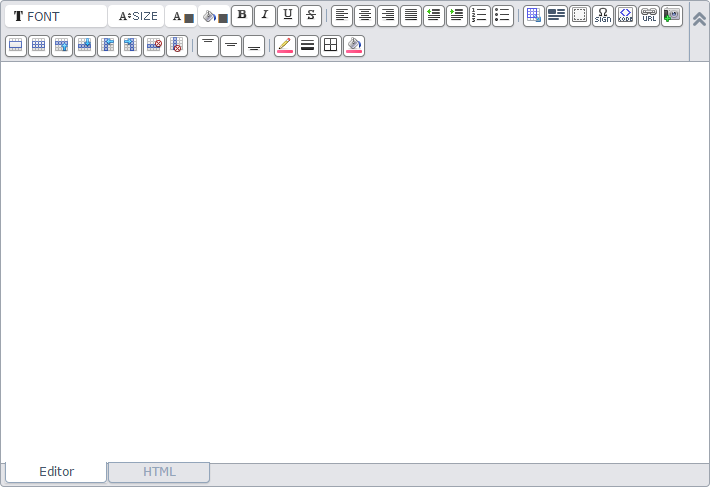
속성명 | 하위 속성명 | 타입 | 설명 |
editor | url | string | editor.html 의 경로를 지정합니다. |
showToolbar | boolean | 툴바 영역을 보일지 여부를 지정합니다. | |
toolbarButtons | array | 툴바에 사용할 기능을 지정합니다. 지원하는 툴바 기능은 하단을 참고하세요. | |
allowResize | boolean | 에디터 영역의 리사이즈 허용 여부를 지정합니다. | |
showEditMode | boolean | HTML 편집모드을 보일지 여부를 지정합니다. | |
loadCallback | function | 에디터의 초기화가 완료된 후 호출되는 callback 함수를 지정합니다. | |
resizeCallback | function | 에디터의 사이즈가 변경될 때 호출되는 callback 함수를 지정합니다. | |
contentMinHeight | number | 에디터 본문 영역의 최소 높이를 지정합니다. 리사이즈 시 최소 크기보다 작아지지 않습니다. | |
contentMaxHeight | number | 에디터 본문 영역의 최대 높이를 지정합니다. 리사이즈 시 최대 크기보다 커지지 않습니다. | |
| contentHeight | number | 에디터 본문 영역의 초기 높이를 지정합니다. | |
| contentMinWidth | number | 에디터 본문 영역의 최소 너비를 지정합니다. | |
| contentHeight | number | 에디터 본문 영역의 초기 너비를 지정합니다. | |
| useInitFocus | boolean | 에디터 초기화 시 본문 영역의 포커스 여부를 지정합니다. | |
| table | width | number | 표의 기본 너비를 지정합니다. |
| tdheight | number | 행의 기본 높이를 지정합니다. | |
| headBorderStyle | string | 표 헤더에 적용할 기본 border style을 지정합니다. | |
| headBackgroundColor | string | 표 헤더에 적용할 기본 background style을 지정합니다. | |
| headColor | string | 표 헤더에 적용할 기본 color style을 지정합니다. | |
| bodyBorderStyle | string | 표 바디에 적용할 기본 border style을 지정합니다. | |
| bodyBackgroundColor | string | 표 바디에 적용할 기본 background style을 지정합니다. | |
| bodyColor | string | 표 바디에 적용할 기본 color style을 지정합니다. | |
| image | host | string | 이미지 파일을 등록할 host 경로를 지정합니다. |
| uploadUrl | string | 이미지 업로드 url 로 host 를 제외한 경로를 지정합니다. | |
| deleteUrl | string | 이미지 삭제 url 로 host 를 제외한 경로를 지정합니다. | |
| src | string | 본문에 추가될 url 로 host 를 제외한 경로를 지정합니다. | |
| allowTypes | array | 허용 가능한 확장자를 지정합니다. | |
| maxCount | number | 등록 가능한 최대 개수를 지정합니다. | |
| maxSize | string | 개별 이미지의 업로드 최대 크기를 지정합니다. | |
| maxTotalSize | string | 전체 이미지의 업로드 최대 크기를 지정합니다. |
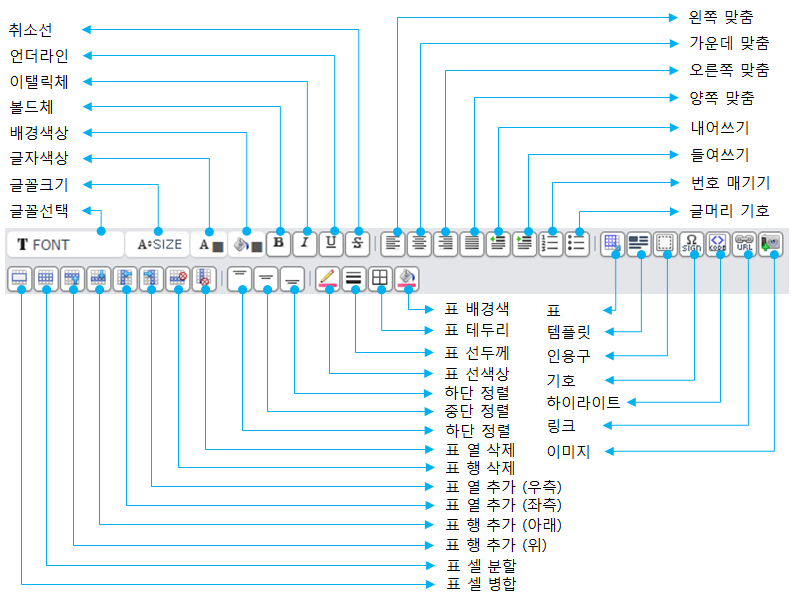
글꼴 | 맞춤 | 삽입 | 표 | ||||
ID | 기능 | ID | 기능 | ID | 기능 | ID | 기능 |
font | 글꼴선택 | left | 왼쪽 맞춤 | layoutTable | 표 | merge | 셀 병합 |
fontsize | 글꼴크기 | center | 가운데 맞춤 | template | 템플릿 | resetMerge | 셀 분할 |
color | 글자색상 | right | 오른쪽 맞춤 | blockquote | 인용구 | insertRowAbove | 위 행 추가 |
bkcolor | 배경색상 | full | 양쪽 맞춤 | specialchar | 기호 | insertRowBelow | 아래 행 추가 |
bold | 볼드체 | indentout | 내어쓰기 | highlight | 하이라이트 | insertColLeft | 좌측 열 추가 |
italic | 이탤릭체 | indentin | 들여쓰기 | link | 링크 | insertColRight | 우측 열 추가 |
underline | 언더라인 | numberlist | 번호 매기기 | linkdel | 링크취소 | deleteRow | 행 삭제 |
strikechar | 취소선 | marklist | 글머리 기호 | image | 이미지 | deleteCol | 열 삭제 |
| verticaltop | 상단 정렬 | ||||||
| verticalmiddle | 중단 정렬 | ||||||
| verticalbottom | 하단 정렬 | ||||||
| tablebdcolor | 선색상 | ||||||
| tablebdheight | 선두께 | ||||||
| tablebdrange | 테두리 | ||||||
| tablebgcolor | 배경색 | ||||||
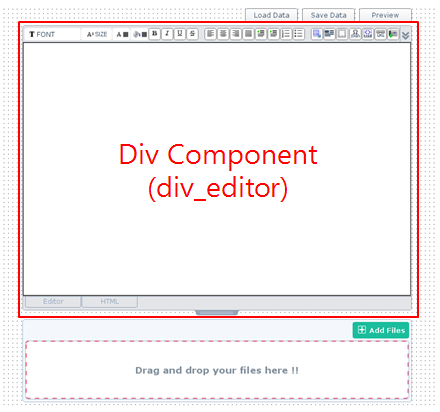
에디터의 setContent 함수를 통해 조회된 데이터(HTML)를 지정하고 setAttachImages 함수를 통해 본문에 등록된 이미지 목록을 표시할 수 있습니다.
3. 데이터 저장
btn_save 컴포넌트의 onclick 이벤트 핸들러에는 실제 데이터를 저장하는 코드는 없으며 첨부파일 저장/삭제 및 에디터 내용을 얻어오는 예시 코드가 작성되어져 있습니다.
에디터의 getContent 함수를 통해 현재 편집중인 내용(HTML)을 얻어올 수 있습니다.
※ 파일 첨부에 관련된 내용은 File 업로드 & 다운로드 샘플 아티클을 참고하세요.
4. 미리보기
btn_preview컴포넌트의 onclick 이벤트 핸들러에는 현재 편집중인 에디터 내용을 미리보는 팝업화면을 호출하는 예시 코드가 작성되어져 있습니다.
에디터의 getContent 함수를 통해 편집중인 에디터의 내용을 얻어온 후 showModal 함수를 통해 미리보기 샘플화면(RichTextEditorPreviewSample.xfdl)을 호출합니다.
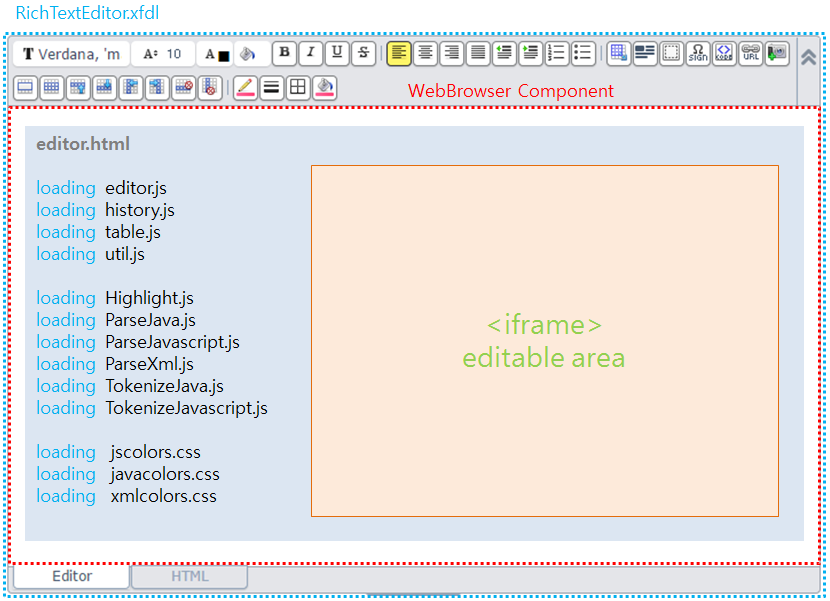
미리보기 팝업화면에는 WebBrowser 컴포넌트가 하나 존재하며 Form 의 onload 이벤트 핸들러에서 설정된 preview.html 경로를 연결한 후 로딩이 완료되면 부모창에서 전달 받은 에디터 내용을 표시하게 됩니다.
실행환경 | 증상 |
Runtime | WebBrowser 컴포넌트의 onusernotify 이벤트 핸들러에서 화면 페인팅에 관련된 변경이 발생하는 스크립트 실행 시 바로 반영되지 않고 WebBrowser 영역을 벗어나야 반영됩니다. 예를 들어 본문에 이미지를 첨부한 후 이미지를 선택하면 설정창이 팝업되는데 최초 팝업 이후 두번째 선택 시 팝업되지 않고 WebBrowser 영역을 벗어나야 팝업는 현상이 발생합니다. |
Runtime | WebBrowser 컴포넌트에 연결된 HTML 의 텍스트의 잘라내기(Ctrl+X) 와 복사(Ctrl+C) 가 동작하지 않습니다. |